Quantify the burden
Metrics capture how hard the avoidance system must work and how strongly it disrupts the airspace.
ATM 2019 · Airspace safety
A deep reinforcement learning correction layer helps traditional collision-avoidance logic remain safe and efficient as traffic density rises.
New unmanned operations can push free-flight airspace toward traffic densities that traditional collision-avoidance systems were not designed to handle. More encounters create more alerts, more maneuvering, and a growing decision burden.
Instead of replacing an established avoidance system, this work learns a correction around it. Deep reinforcement learning adapts the system’s decisions for dense environments while preserving the safety foundation of the original logic.
How can proven collision-avoidance logic adapt when dense traffic breaks its operating assumptions?
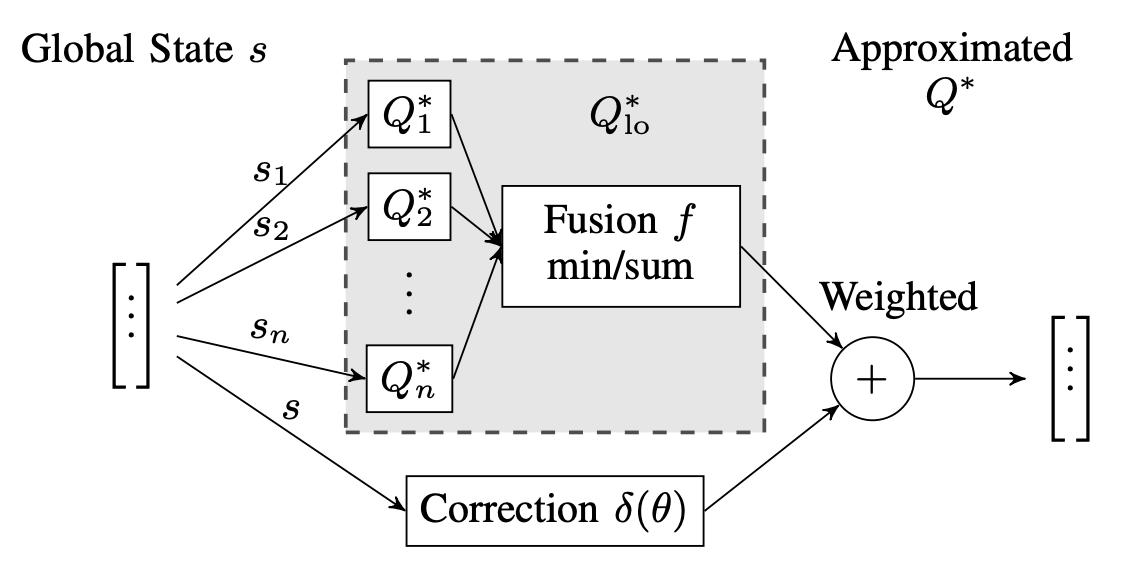
The approach decomposes the global state into pairwise encounters, combines their avoidance values, and adds a learned correction. New metrics quantify both the decision burden placed on the avoidance system and its operational impact on the surrounding airspace.
Metrics capture how hard the avoidance system must work and how strongly it disrupts the airspace.
A deep reinforcement learning function adjusts the aggregated avoidance values for dense encounters.
The corrected system is assessed for both high safety levels and efficient operation under dense traffic.
Learning can improve how a conventional system behaves at the edge of its design envelope.
The corrected collision-avoidance system preserved high levels of safety in dense airspace.
Compared with traditional methods, the corrected approach operated more efficiently under high traffic density.
Decision-burden and airspace-impact metrics make the balance between intervention and efficiency explicit.
ATM Research & Development Seminar · 2019
Air Traffic Management Research and Development Seminar · 2019